

Smart pi DVA GTFS turns public transport timetable and realtime data into automatic passenger announcements. It reads standard GTFS timetables and GTFS-R realtime updates, works out what needs to be announced and when, and places announcement orders into Smart pi DVA for playback on the right channels.
Simple business rules set what is announced at each stop, from on-time arrivals and departures to delays, cancellations and regular next-service updates. Each announcement is built automatically from the stop, route and timing details of the service, so passengers hear clear, consistent and timely information without operators having to make every call.
Smart pi DVA GTFS is part of the Smart pi ECOsystem. Realtime data in SIRI or custom formats can be converted to GTFS by Smart pi RTA, and Smart pi SIP can request the next service for a stop when a call connects, so passengers using a Smart pi HLP help point hear up-to-date service information.
Key features
- Automatic passenger announcements from GTFS timetables and GTFS-R realtime updates
- Ready-made triggers for on-time, delayed and early running, cancelled, terminating, passing and not-in-service services
- Repeat announcements for long delays, and regular next-services announcements with “due in” times
- Handles services that split, join or change destination without conflicting announcements
- Per-channel priorities so the most important message is heard first
- Trip analysis tools and a full order history of what was announced and why
- LDAP / Active Directory login with group permissions and audit logging
- REST API for remote monitoring and to enable or disable rules and channels
Specifications
Business rules
- Rules are checked against live service data every 2 seconds
- Triggers for early, on-time and delayed arrivals and departures, cancellations, and terminating, passing and non-revenue services
- Announcements one or two stops before the end of a trip
- Repeat announcements refresh realtime data on every repeat, and stop when they are no longer needed
- Next service only option to avoid repeated announcements at busy stops
- Request-stop services included in stopping patterns and rules
- Filter out services across a whole feed, or per timetable feed
- Alternate announcements for services that split, join or change headsign, detected by block or vehicle
Announcements
- Built from audio libraries of numbers, letters, times, stop names and route names, with natural falling inflection
- Stop and route name lists reload straight from the GTFS feed
- Rules assigned to each DVA output channel, with their own priority
- Each announcement can also send Smart pi EYE realtime text, messages or mode changes
- Help point callers hear live service information: Smart pi SIP passes the stop and DVA channel when a call connects
Monitoring and tools
- Dashboard: announcements today, live trips tracked, feed freshness and health, and rule processing speed
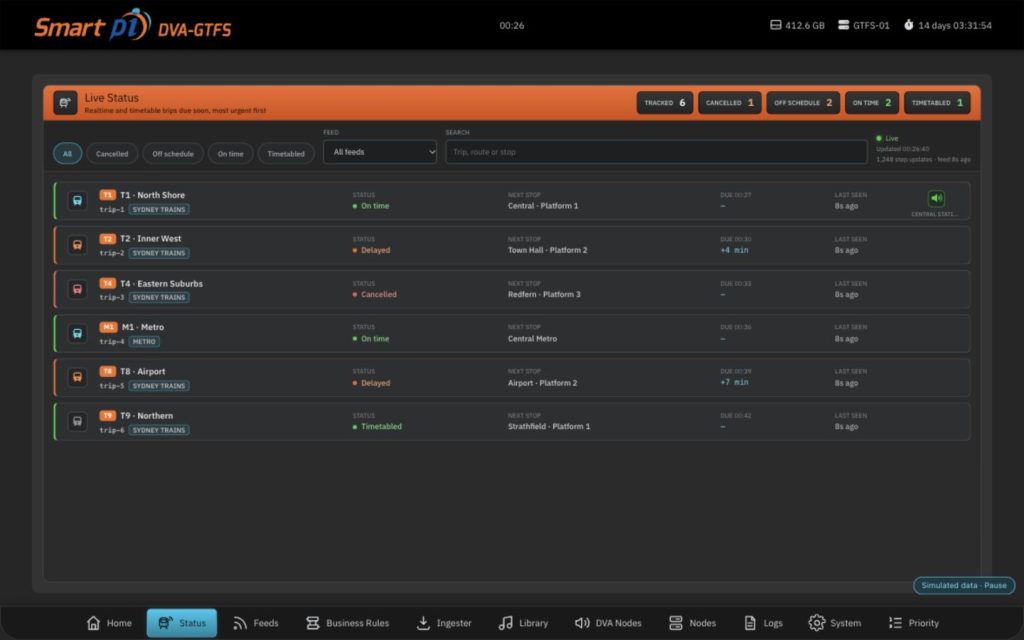
- Live status of every tracked service: on time, late, cancelled or timetabled
- Trip analysis, including recording realtime changes at a stop
- Order log with a live view and export, showing the rule, priority, channel and audio files for every announcement
- Temporary diagnostic logging, automatic log clean-up and custom branding
Technical data
| Data | GTFS timetables and GTFS-R realtime feeds (other formats via Smart pi RTA) |
|---|---|
| Output | Announcement orders to one or more Smart pi DVA servers and channels |
| Triggers | On-time, delayed, early, cancelled, terminating, passing, not in service and next services |
| Control | Web interface with mobile support, and REST API |
| Security | LDAP / Active Directory with group permissions, HTTPS, API keys and audit logs |
| Platform | Windows or Linux: bare metal, virtualised, on premises or cloud |
| Server sizing | From 16 CPU cores, 16 GB memory and 100 GB storage on a single server |
Connectivity
- Smart pi DVA
- Smart pi EYE
- Smart pi RTA
- Smart pi SIP
- Smart pi HLP help and information points
- Standard GTFS and GTFS-R data sources