

Smart pi SIP is a software SIP audio endpoint that connects sound card audio channels to SIP calls. Each SIP extension can be routed to its own input and output channels, so audio sources and speaker zones can be linked over LANs, wide area networks and the internet.
Extensions can register to the Smart pi PBX or any standard SIP server, or connect point-to-point without a PBX. High-quality OPUS audio with adaptive jitter buffering keeps audio clear on networks where linear audio such as Dante isn’t practical. It suits public address, paging, announcement, intercom and broadcast-style applications.
Smart pi SIP complements the Smart pi PBX: the PBX provides full telephony (extensions, call routing and trunks), while Smart pi SIP handles the audio between sound cards and SIP. The same technology powers the NAM SIP option for the Smart pi NAM, bringing wide-area and internet connectivity across the Smart pi ECOsystem.
Key features
- Connects sound card audio channels to SIP calls, in both directions
- Exceptional audio quality with OPUS, plus G.711 (PCMA / PCMU) for compatibility
- Registers to the Smart pi PBX or any standard SIP server, or connects point-to-point
- Up to 512 audio channels per server
- Physical sound cards, or virtual Dante and AES67 sound cards
- Adaptive jitter buffer profiles for LAN, WAN, 5G / mobile and resilient links
- Auto answer, auto dial with automatic reconnect, and speed dials
- REST API and AES70 (OCA) for remote control and monitoring
Specifications
Calls and routing
- Route each extension to its own sound card input and output channels
- Codec priority and OPUS settings per extension: bit rate, stereo, dual mono or mono
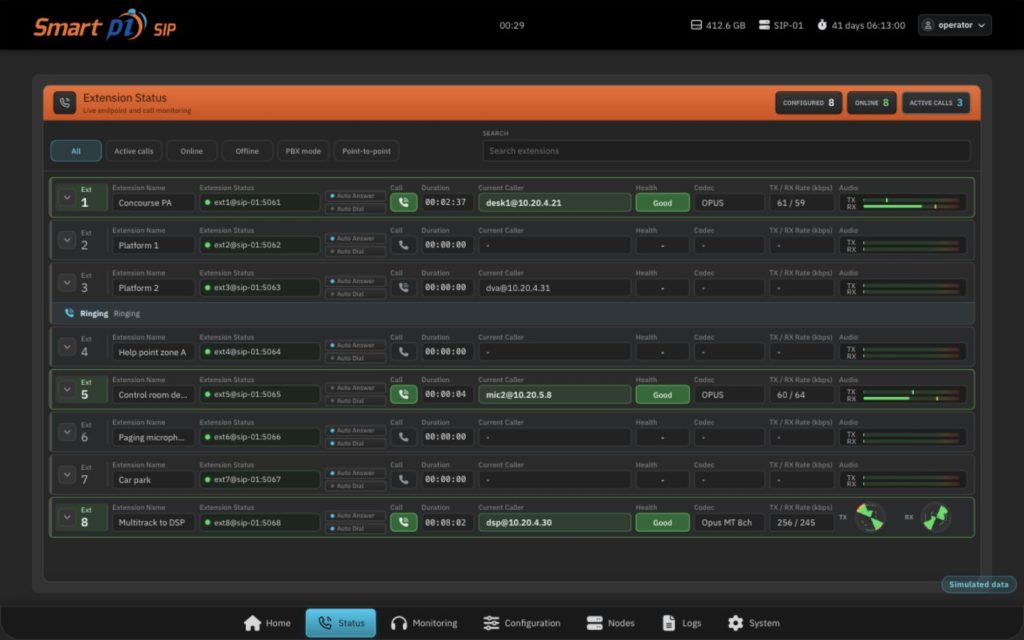
- Live status for every extension: call state, audio meters, call duration, jitter and packet loss
- Works with Smart pi DVA GTFS and Smart pi HLP: when a call connects, the stop and DVA channel are passed on for live service information
- Runs standalone as a pure audio-to-SIP bridge, or as part of the Smart pi ECOsystem
Technical data
| Protocol | Standard SIP, with registration or point-to-point calling |
|---|---|
| Codecs | OPUS (48 kHz, 8–256 kbps), G.711 A-law (PCMA) and µ-law (PCMU) |
| Channels | Up to 512 audio channels per server, depending on sound card and licence |
| Audio | 48 kHz, with 24-bit sound card support |
| Sound cards | ALSA on Linux; ASIO or WDM on Windows; virtual Dante and AES67 |
| Jitter buffer | Auto (40–500 ms), LAN, WAN, 5G / mobile and resilient profiles |
| Control | Web interface, REST API and AES70 (OCA) |
| Security | LDAP / Active Directory with group permissions, and API keys |
| Platform | .NET 10 on Windows or Linux: bare metal, virtualised, on premises or cloud |
Connectivity
- Smart pi PBX
- Smart pi DVA and DVA GTFS
- Smart pi DSP
- Smart pi NAM with the NAM SIP or Auracast option
- Smart pi HLP help and information points
- Most IP PBXs and SIP servers